
Why do the kicks of slender Thai fighters feel so overwhelmingly “heavy”?
Anyone who has spent time in a fight gym has witnessed this scene at least once.
A Thai trainer—barely 160 cm tall, with limbs as slender as sticks—casually swings a kick into a heavy bag.
Yet the impact detonates with a thunderous boom, reverberating through the gym as the bag folds sharply in half, as if the entire building had shuddered.
Now contrast this with a muscular beginner, capable of bench-pressing 100 kg, who launches a full-power kick into the same bag.
The result? A light slap—and the bag merely ripples on the surface.
“Thais must have different bone structures.”
“Their physical strength is unreal.”
Such explanations are often whispered as if they were plausible truths.
Scientifically speaking, however, they are incorrect.
This is not magic.
What you are witnessing is a near-perfect adaptation to Newtonian mechanics.
In this three-part series, we will rigorously dissect the Muay Thai kick (Tae Lam Tua)—a movement refined over centuries—through the lens of modern sports biomechanics and functional anatomy.
This is not a matter of intuition or mysticism.
Every phenomenon discussed here is fully explainable by the laws of physics.
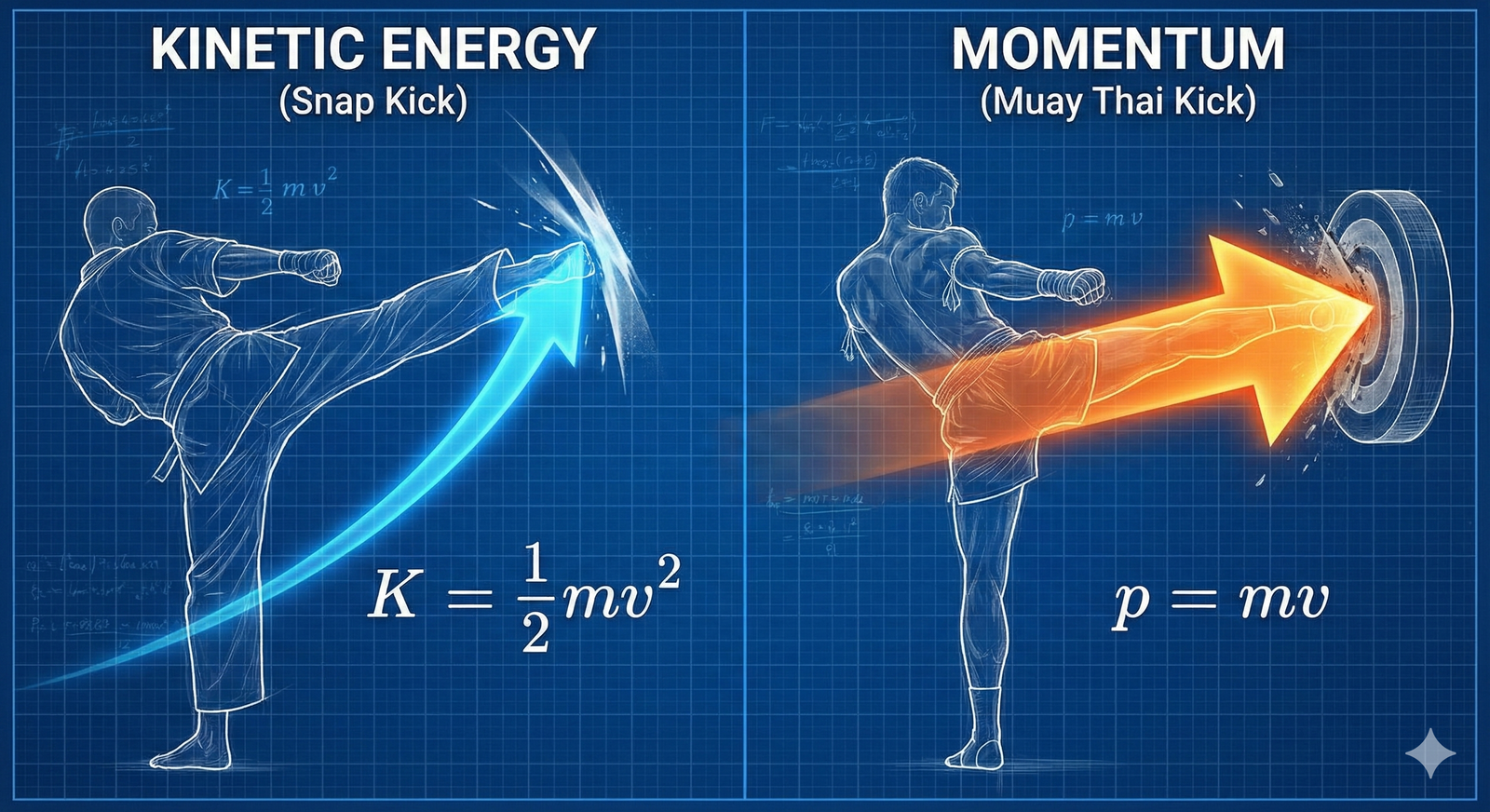
1. The Equation of Destructive Power: Kinetic Energy vs. Momentum
When people talk about the “power” of a strike, they often conflate speed with heaviness.
From a physics standpoint, these are fundamentally different concepts.
Once organized properly, two distinct striking paradigms emerge.
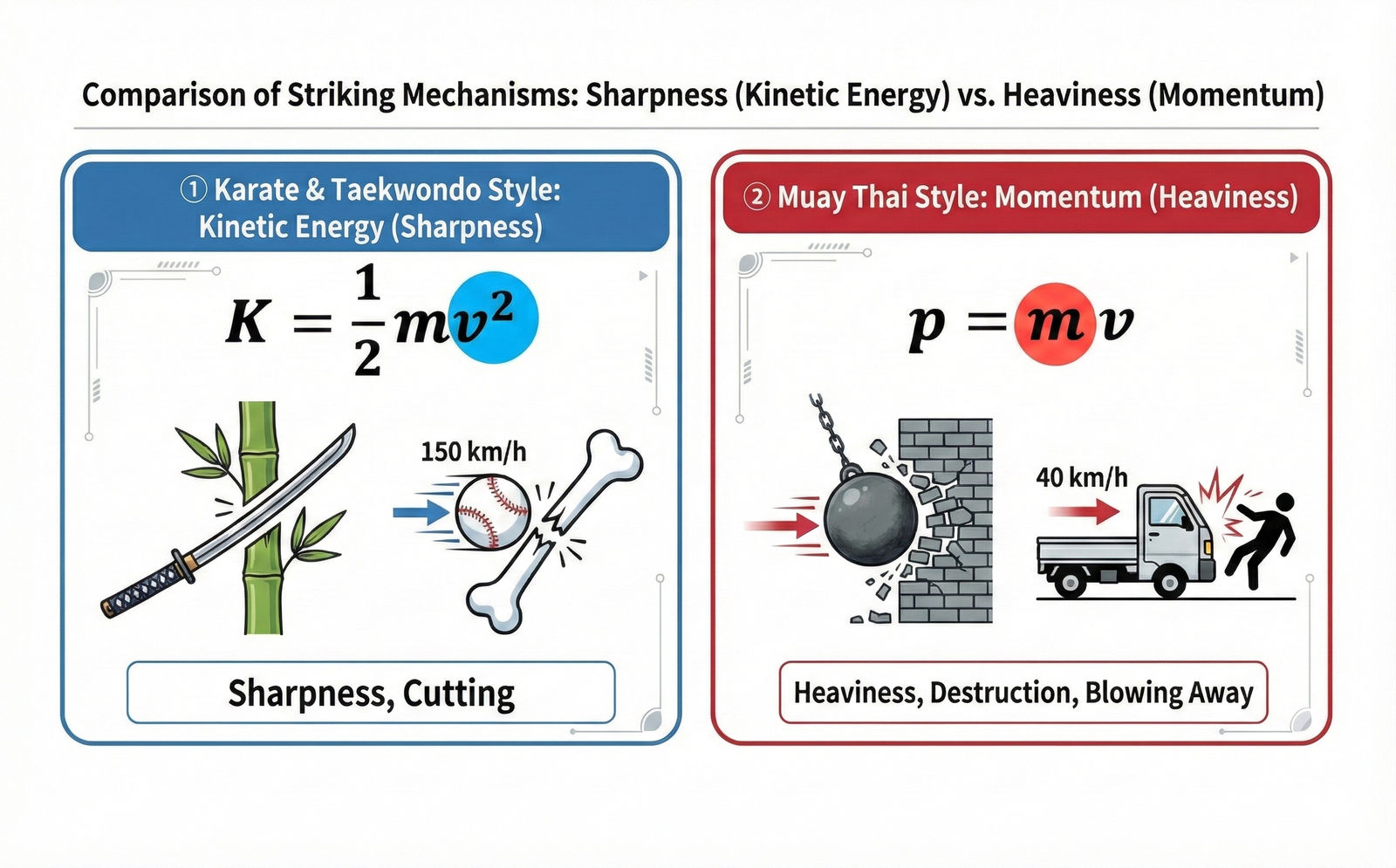
① Karate / Taekwondo Style — Kinetic Energy
Snap-based kicks derived from Karate and Taekwondo are designed to maximize kinetic energy, expressed by the equation:
K = 1/2 × mv²(m: mass, v: velocity)
The critical point here is that velocity (v) is squared.
This means that even with a relatively small mass, increasing speed dramatically amplifies energy output.
This is precisely why these styles emphasize knee chambering and explosive extension below the knee—to maximize terminal velocity.
- Physical conclusion: A strike optimized for sharpness—cutting the surface and violently shaking the brain.
- Metaphor: A Katana. (Sword)
② Muay Thai Style — Momentum
Muay Thai, by contrast, prioritizes the transfer of momentum, defined as:
p = mv
Here, the formula is linear.
The essence of Muay Thai lies not in chasing velocity, but in redefining mass.
Rather than swinging only the leg—roughly 15–20% of body weight—the technique commits the entire body mass into the strike.
The result is an overwhelmingly large momentum transfer.
- Physical conclusion: A strike optimized for heaviness—physically displacing the opponent and crushing structural integrity.
- Metaphor: A Wrecking Ball.
💡 Put simply:
A baseball traveling at 150 km/h can fracture bone and cause intense pain—this is Karate logic.
But a small truck moving at just 40 km/h will send you flying and threaten your life—this is Muay Thai logic.
Muay Thai is, at its core, the technology of turning the human body into a truck.
2. Rotational Mechanics: Maximizing the Moment of Inertia
How, then, does a human body become a “truck”?
The reason Muay Thai fighters kick with a fully extended leg—like swinging a bat—lies in rotational dynamics.
Here we introduce the Moment of Inertia, a quantity representing resistance to rotation and, crucially, resistance to stopping.
I = mr²(I: moment of inertia, r: distance from the axis of rotation)
Notice that distance (r) is squared.
The farther the mass (the foot) is from the rotational axis (the trunk and spine), the more dramatically rotational energy increases.
- Bent-knee kick: Small radius (r). Easy to rotate, but limited energy capacity.
- Straight-leg kick: Maximum radius (r). Harder to rotate, but impact force increases by an order of magnitude.
Thus, the common gym instruction—“Don’t fold your leg. Swing it big.”—is not a matter of aggression or spirit.
It is a precise physical directive: maximize (r) to maximize (I)
💡 Metaphor:
Choking up on a baseball bat makes it easy to swing—but the ball won’t travel far.
Grip the bat at full length and swing hard—it feels heavier, but you hit a home run.
Muay Thai fighters treat their legs as bats held at full extension.
3. The Kinetic Chain: The Double-Pendulum Principle
“Don’t try to swing your leg fast.”
This advice, confusing to many beginners, cuts directly to the core of biomechanics.
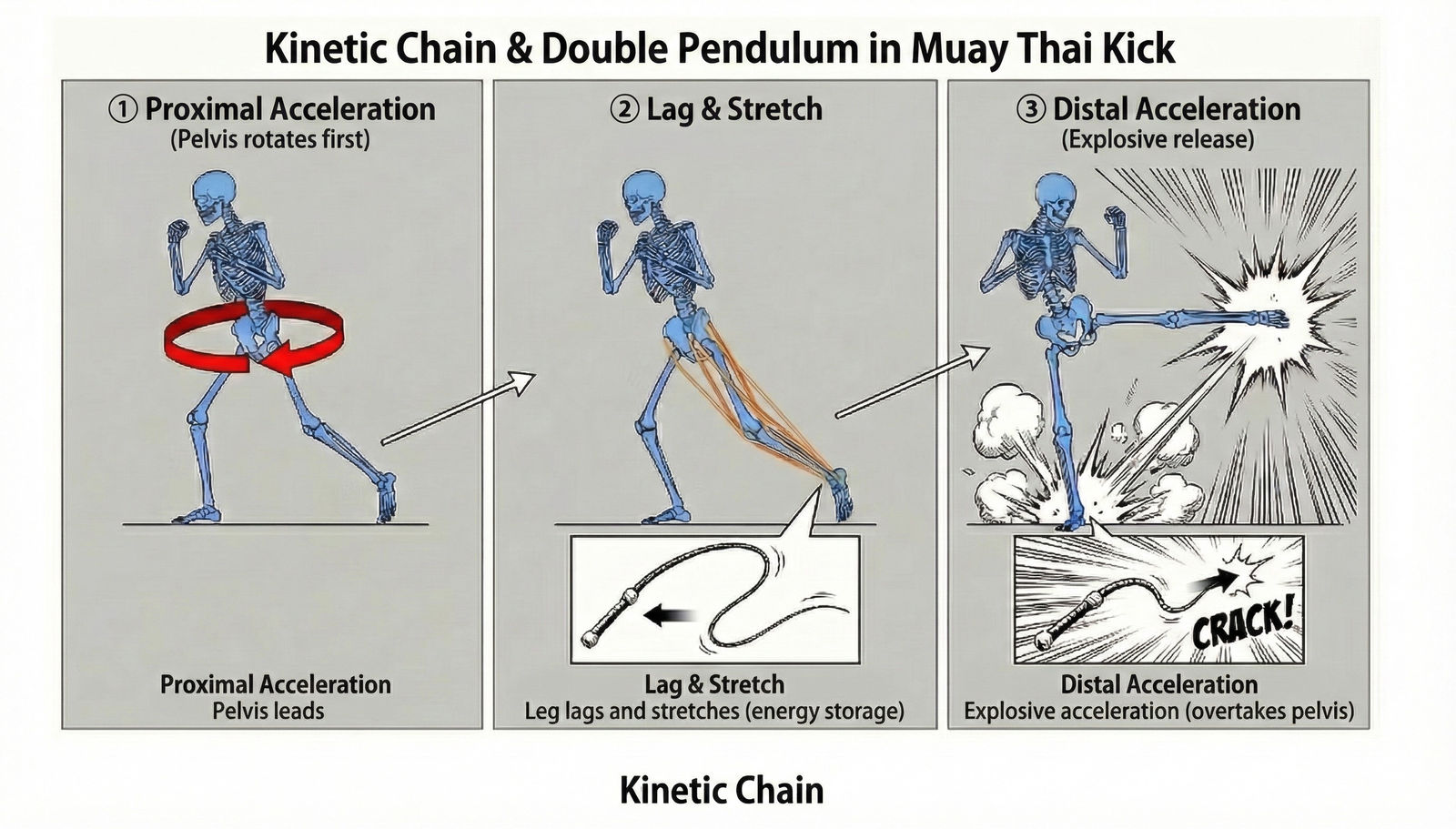
Muay Thai kicking mechanics closely resemble a Double-Pendulum system.
In this model, the pelvis acts as the proximal segment, while the leg functions as the distal segment, connected via a hinge.
Within such a system, distal acceleration emerges only through lag.
- Proximal acceleration: The pelvis generates powerful rotational torque.
- Lag: Due to inertia, the leg momentarily lags behind the pelvis.
- Distal acceleration: This delay stretches muscles and fascia—elastic tissues—which then recoil, propelling the leg explosively past the pelvis.
What happens if you tense up and attempt to swing the leg actively from the beginning?
The lag disappears. The double pendulum collapses into a rigid single segment—and acceleration is lost.
💡 In other words:
Think of a whip or nunchaku.
When you snap the handle (pelvis), the tip (leg) follows late—then accelerates violently, even breaking the sound barrier.
Move both ends simultaneously, and the whip will never crack.
To make the leg fast, you must not try to move the leg.
This apparent paradox is not philosophy.
It is physics.
(In Part 2, we will examine the physics of the moment of impact.)