
The Logic of the “Unblockable” Kick and the Body Mechanics of Masters
In this final installment, we step into even more specialized territory. Why is it that elite fighters’ kicks are “unblockable,” even when you see them coming?
The answer lies in the limits of human neurophysiology—and in the refined body mechanics of true masters.
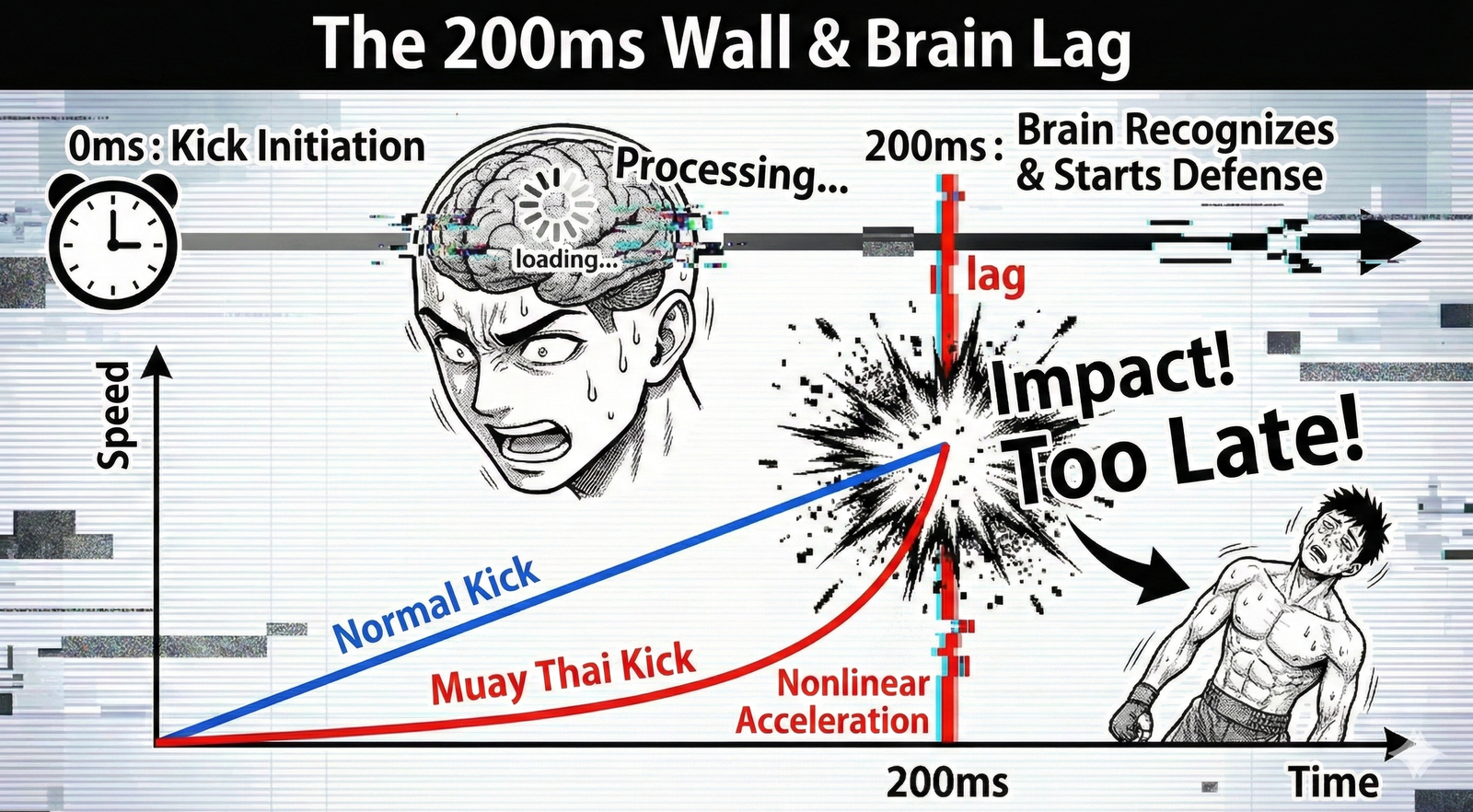
1. The Physics of “Unblockable”: The 200-Millisecond Wall
“Too fast to see” belongs in the world of manga. In reality, the scientifically correct explanation is this:
You can see it—but your brain cannot process it in time.
The 200 ms Limit (Reaction Time)
When a human receives a visual stimulus (“The opponent moved!”), processes it in the brain, and sends a command to the muscles to initiate a defensive action, even the fastest individuals require approximately 200 milliseconds (0.2 seconds) of latency.
Muay Thai kicks are engineered to exploit this physiological limit.
Non-linear Acceleration
The initial movement is slow and smooth, deliberately lulling the opponent’s brain into a false sense of safety. Then, in the final 100 milliseconds before impact, the kick accelerates explosively.
By the time the opponent recognizes danger, the leg has already reached maximum velocity.
Three-Dimensional Trajectory (3D Trajectory)
A conventional round kick travels along a horizontal, two-dimensional path. Muay Thai kicks, however, arc downward or upward on an oblique, three-dimensional trajectory.
This disrupts the defender’s parrying vector calculations and timing.
💡 In simple terms
You can catch a ball thrown straight at you. But a ball dropping unpredictably from above is far harder to judge.
Muay Thai kicks function like a virus, deliberately inducing processing lag in the opponent’s brain.
2. Left–Right Asymmetry: The Left Is a “Spear,” the Right Is a “Cannon”
“If you mirror the right kick, you get the left.” Anatomically, this is a serious mistake.
Due to human body structure (in an orthodox stance), the left and right sides follow different kinetic-chain routes.
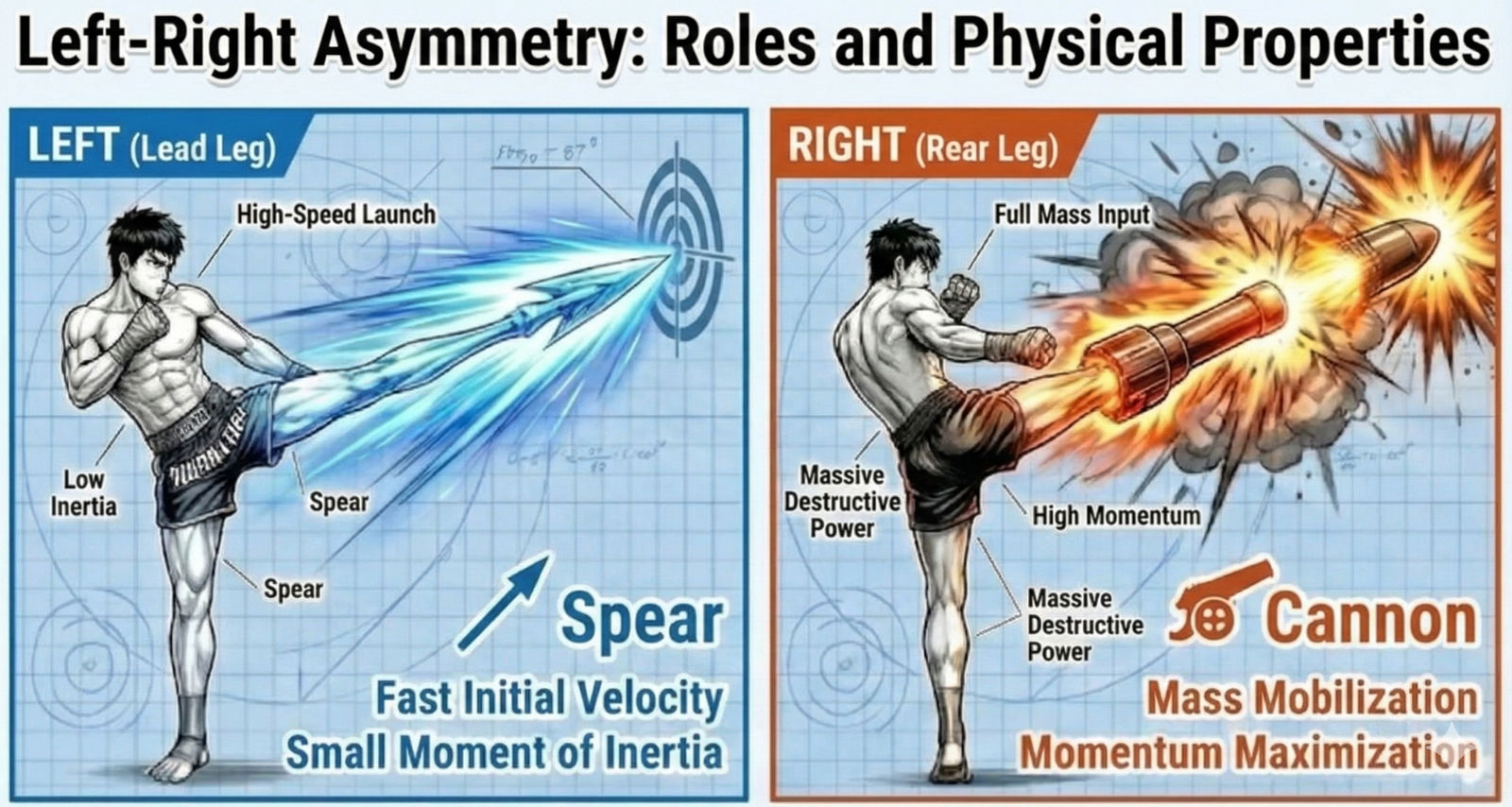
Left Middle Kick (Lead Leg): Reduced Motion
The left middle kick requires a shorter pelvic rotation and can be launched with minimal preparation, giving it exceptional stealth.
Physical characteristics: Smaller moment of inertia (I), faster initial velocity.
Role: A “shield” and a “spear” that neutralizes the opponent’s right arm.
Right Middle Kick (Rear Leg): Mass Mobilization
The right middle kick must travel a longer distance from the rear, allowing it to generate massive kinetic energy.
Physical characteristics: Full-body mass transfer maximizes momentum (p = m × v).
Role: A “cannon” that blows through the opponent’s guard.
True masters understand these asymmetric physical properties—speed on the left, mass on the right—and deploy them tactically.
3. Relaxation and Tensegrity: Kicking with Structure
“Relax your body” is often said—but complete limpness, like a jellyfish, produces no power.
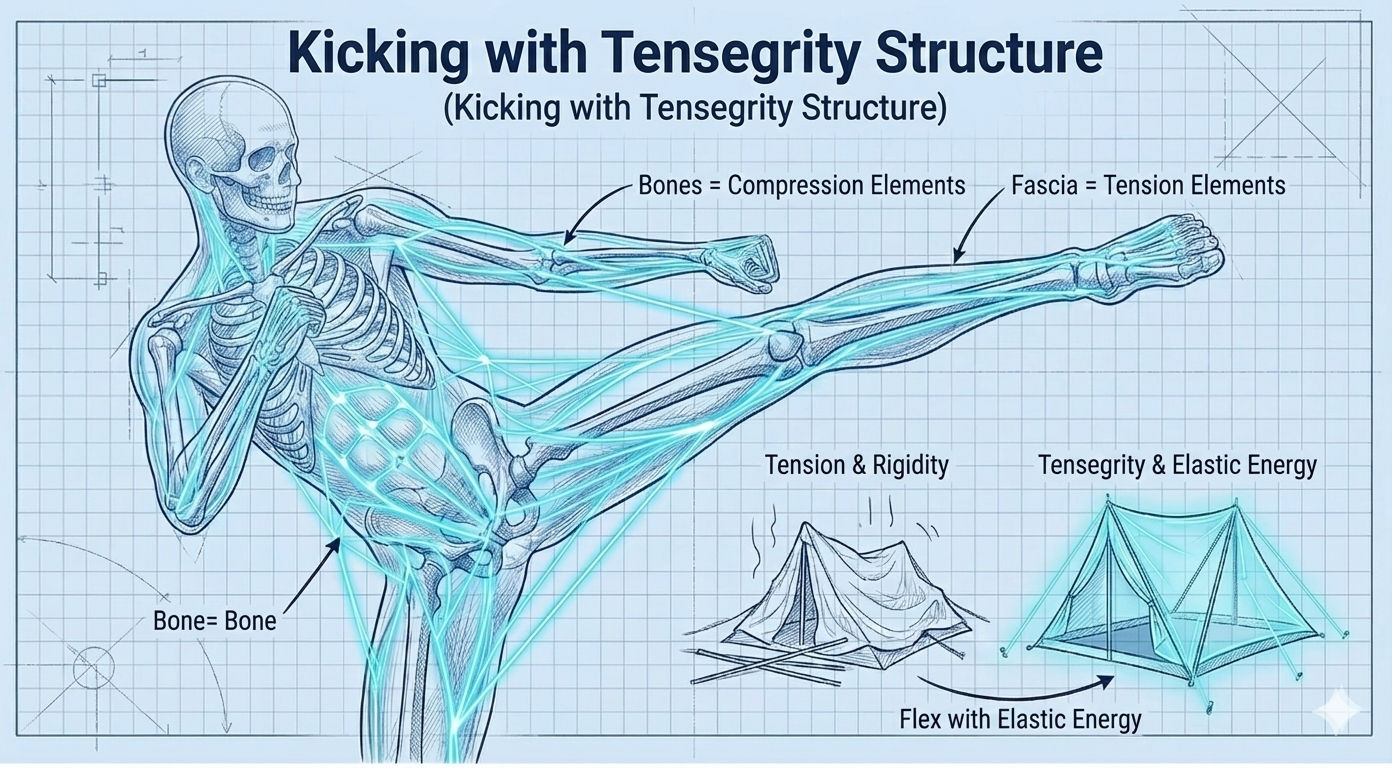
The real goal is a tensegrity structure (tensional integrity).
Braced by Bones, Suspended by Fascia
Imagine a tent. The poles (bones) are rigid, while the ropes (fascia) are taut.
In Muay Thai, “relaxation” means releasing unnecessary muscular tension while maintaining the body-wide tension network—the anatomy trains.
- Incorrect: Rigidly tensing muscles to form a solid rod → energy does not transmit.
- Correct: Centrifugal force stretches the fascia, and its stored elastic energy launches the leg like a slingshot.
By using this passive acceleration, fighters generate whip-like power without relying on raw muscle strength.
Conclusion: Embedding Science into the Unconscious
Throughout this series, we have dissected Muay Thai using physical laws (F = ma, L = Iω, J = FΔt) and anatomical terminology.
But in the ring, thinking “Now I should maximize my moment of inertia…” is far too slow.
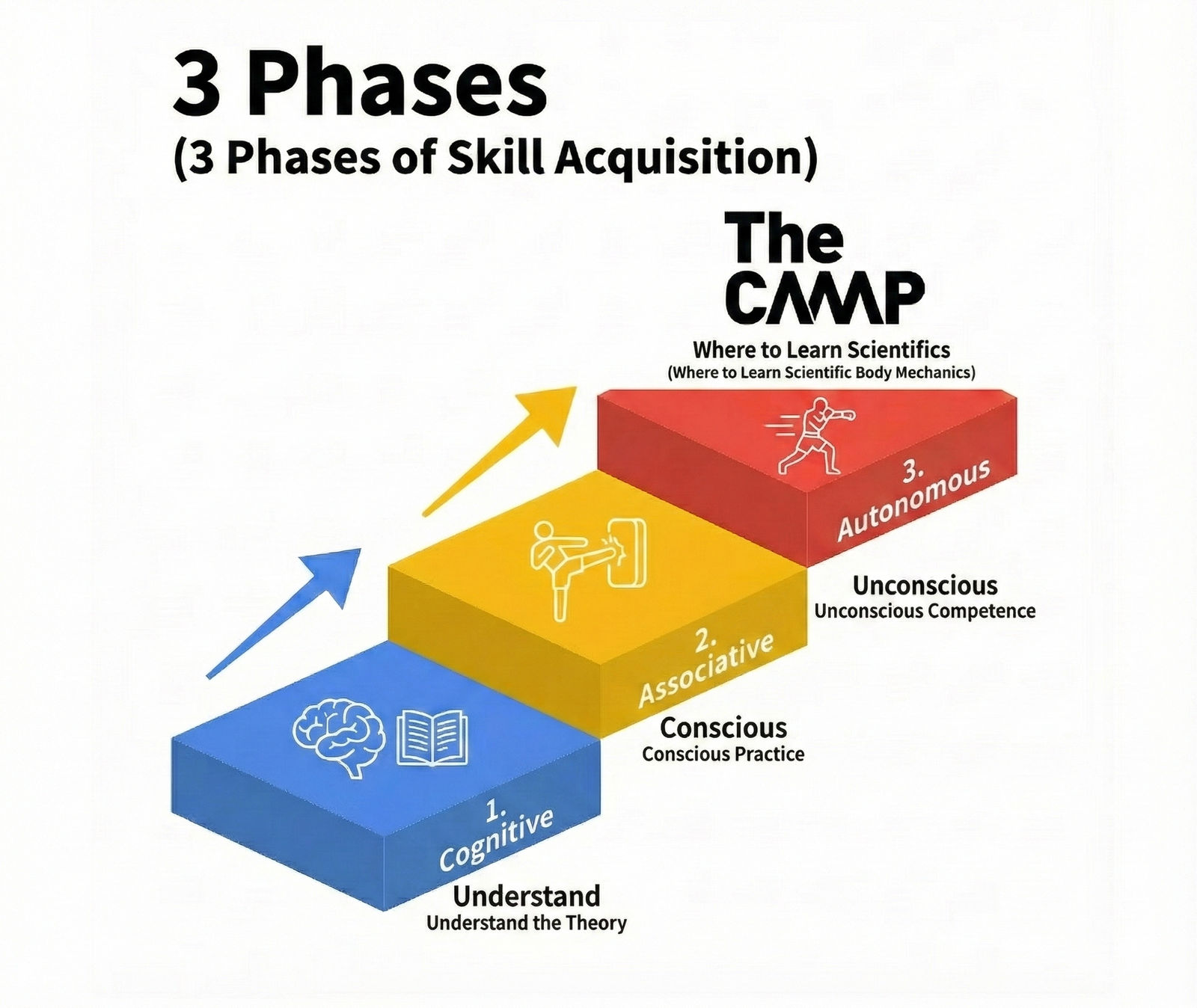
Skill acquisition follows three phases:
- Cognitive: Read, understand the logic, and learn why it works.
- Associative: Use drills to consciously control the body. “That one started from the pelvis.” “That one let the knee lead.”
- Autonomous: Move correctly without conscious thought, fully aligned with physical laws.
This is mastery.
The beauty of Muay Thai form is not aesthetic decoration. It is functional beauty—the inevitable result of optimizing movement in harmony with mass, gravity, and centrifugal force.
May your kick evolve from a forceful action into a martial art grounded in scientific intelligence.
Final Words — What Is a Perfect Muay Thai Kick?
A Muay Thai kick is not a technique dependent on talent or brute strength.
Mass, gravity, rotation, centrifugal force, and human anatomy— when you learn a way of moving that fully conforms to physical law and anatomy, this level of kicking is attainable by anyone.
At The Camp Muay Thai Gym, we do not rely on vague sensations or mental slogans.
We break down why the body moves, and why that form is optimal— from scientific, physical, and anatomical perspectives— and systematically embed it into your body.
You do not become strong by accident. You do not force the kick.
By following the laws of nature, along the shortest path possible, you acquire a genuine Muay Thai kick as a reproducible skill.
If you want to understand why Thai fighters’ kicks are heavy— and then produce that same kick with your own body—
If you are serious about mastering the Muay Thai kick, there is only one place you should come.
We look forward to welcoming you at The Camp Muay Thai Academy.