
What Does Physics Reveal at the Moment of Impact?
In Part 1, we proved that the destructive power of the Muay Thai kick lies in two factors: the mobilization of mass (m) and the maximization of the moment of inertia (I). In this second part, we examine how that massive energy is actually transferred into the opponent’s body—stepping into the science of body mechanics and collision.
1. Pelvis-Driven Anatomy: Rewriting the Operating System
Many experienced martial artists struggle with Muay Thai movement because the internal motor program (the brain’s “OS”) is different. Anatomically speaking, the “engine” they are using is completely different.
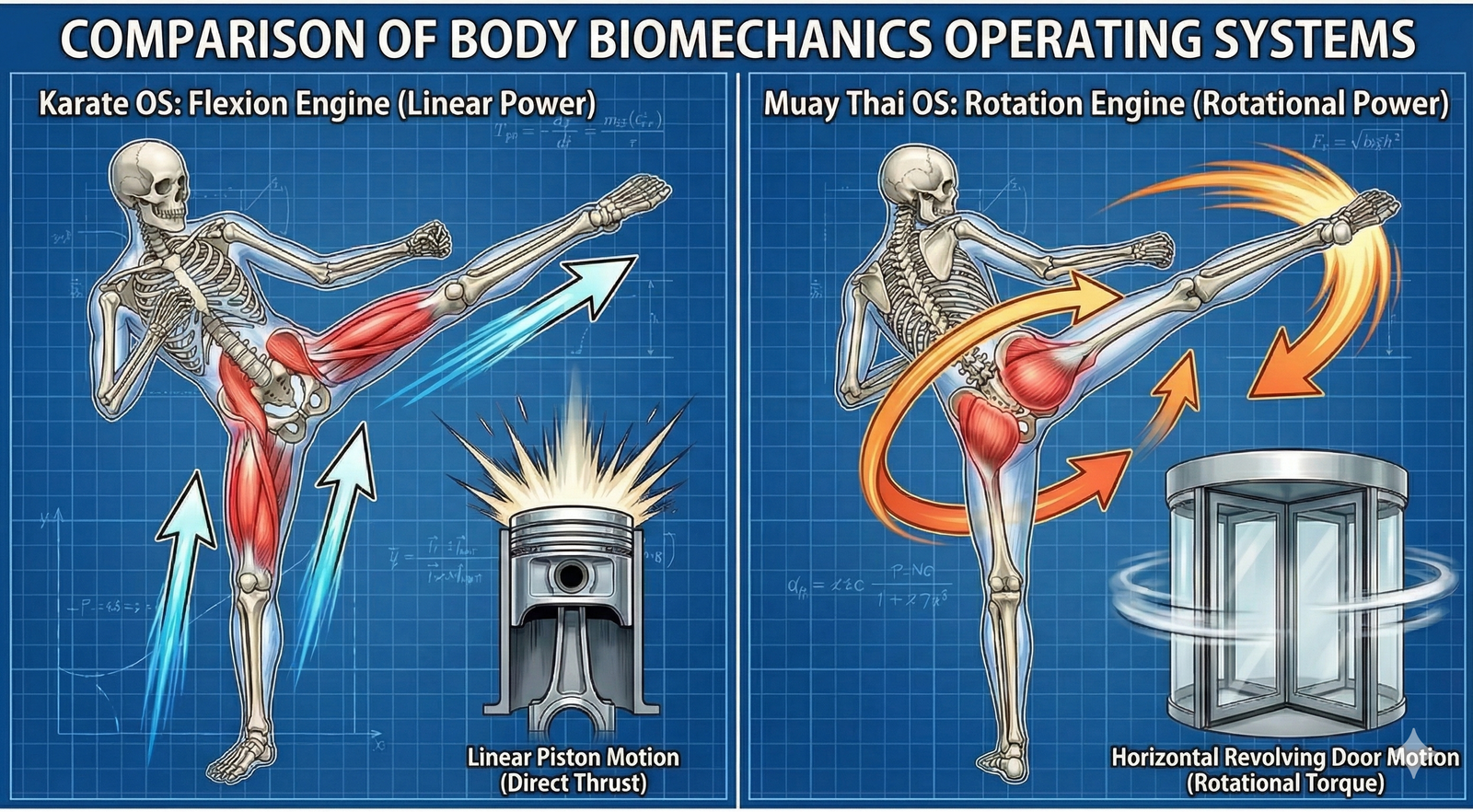
The left shows the Karate OS “flexion engine,” where the kick is produced by a linear piston-like motion that lifts the leg. The right shows the Muay Thai OS “rotation engine,” where a horizontal pelvic rotation swings the leg out through centrifugal force—like a revolving door.
Body-Control OS Comparison
Karate OS: Flexion Engine
- Prime movers: Iliopsoas, rectus femoris
- Mechanism: A piston-like action that lifts the femur forward
- Characteristics: Linear and direct—optimized for the shortest path
Muay Thai OS: Rotation Engine
- Prime movers: Gluteus maximus, gluteus medius, deep external rotators
- Mechanism: A horizontal rotation of the pelvis itself—like a revolving door
- Characteristics: Uses centrifugal force to collide with the opponent using mass
In Muay Thai, the intention to “lift the leg” becomes noise. There is only one physically correct sequence for the rotation engine:
“Rotate the pelvis, and the leg rises on its own due to centrifugal force.” This sequence—and only this sequence—is correct.
2. The Science of the Supporting Leg: Why Does the Knee Straighten?
At the moment of impact, elite fighters’ supporting legs show a raised heel and a fully extended knee. This is not “standing on tiptoe.” It is an inevitable outcome driven by three physical principles.
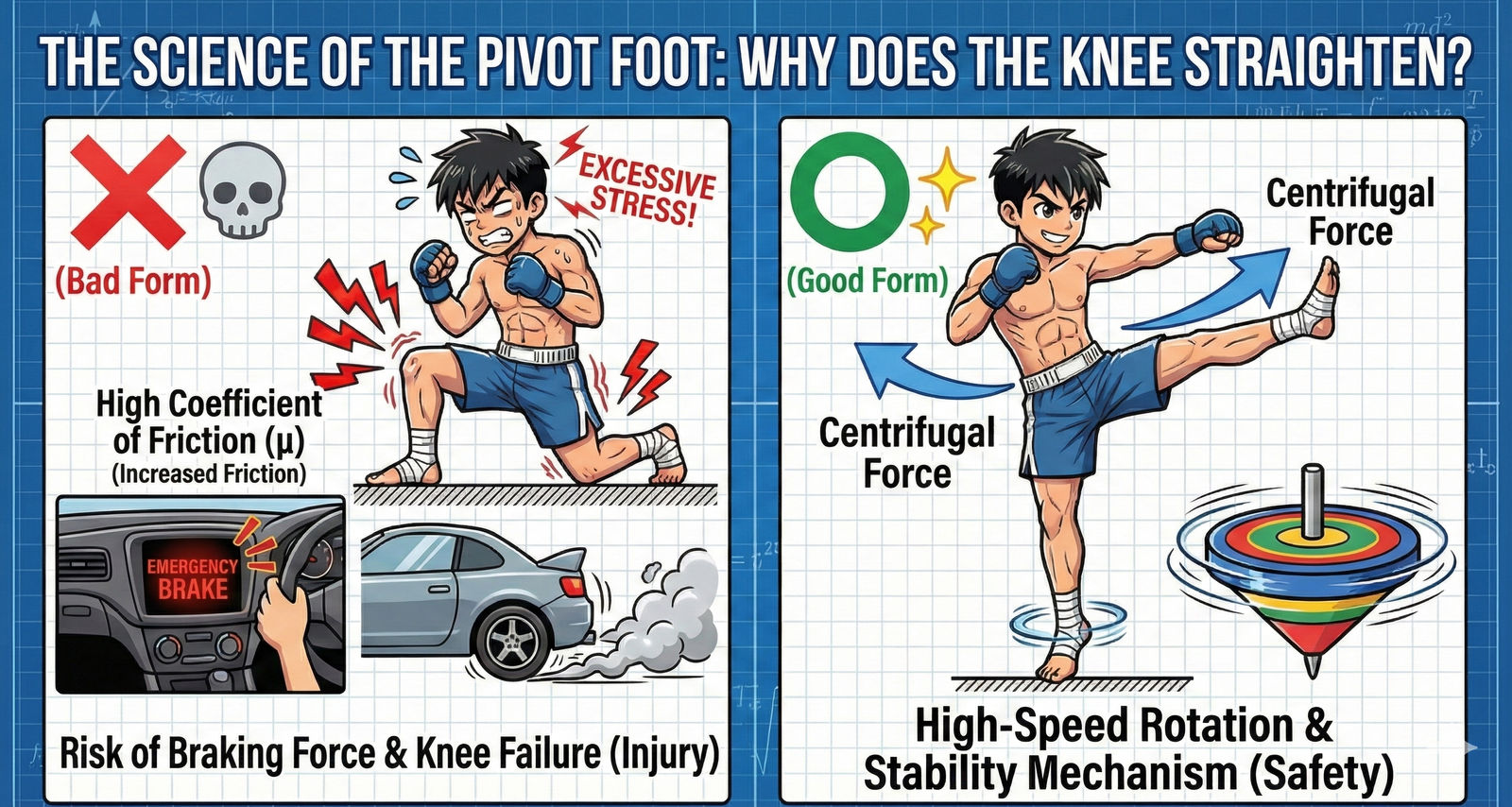
The left shows a dangerous example: trying to rotate with the heel planted increases frictional resistance and concentrates stress on the knee. The right shows the correct action: lifting the heel and letting centrifugal force take over allows the knee to straighten passively, achieving both high-speed rotation and safety.
Why does the knee straighten?
1) Minimizing frictional resistance (Pivot)
With a flat foot, the coefficient of friction μ against the floor increases, acting as a brake on rotation. By lifting the heel (heel-up) and reducing ground contact to a single point under the ball of the big toe, the body can rotate freely—like a spinning top.
2) Converging the radius of rotation
By making the rotational axis thin and tall, angular velocity Ω is preserved (conservation of angular momentum).
3) Passive extension (Passive Extension)
This is the most important factor. When the pelvis rotates violently, centrifugal force pulls the body outward. If the athlete attempts to resist this force by keeping the knee bent, a powerful twisting torque loads the knee joint and damages the ligaments.
The knee is not being consciously straightened. It is being passively extended—pulled straight by rotational energy itself.
💡 In other words
The extension of the supporting leg exists to generate power and to prevent injury at the same time. Trying to rotate with a bent knee is like pressing the accelerator with the parking brake engaged. The vehicle (the knee) breaks.
3. Impact Anatomy: The “Surface” and “Edge” of the Tibia
The complaint “my shin hurts when I kick” often comes from misunderstanding anatomical contact.
The cross-section of the tibia is not circular—it is triangular.
- Medial surface: Flat, dense, and highly resistant to impact
- Anterior border: A knife-like sharp bony ridge (an unforgiving edge on direct contact)
A physically correct impact follows this precise micro-sequence:
- Contact: Initial contact is made with the strongest medial surface (to prevent self-injury).
- Drive: 0.01 seconds after contact, the hip internally rotates further—screwing in.
- Gouge: The tibia rotates, shifting the contact point from surface to anterior edge.
💡 An analogy
“Strike with a hammer—then immediately gouge with a knife.” This two-stage contact delivers both a bruise (impact) and a tear (laceration) at the same time. This is the true nature of a “cutting” Muay Thai kick.
4. Collision Physics: Maximizing Impulse
Finally, we settle the decisive difference between Karate and Muay Thai—the “pull-back” of the leg—using physics.
- Karate (elastic collision): Pull the leg back the moment it lands (zanshin). Contact time is short, optimized for surface damage.
- Muay Thai (inelastic collision): Do not stop the leg—let it pass through the opponent (follow-through).
The total impact delivered to the opponent—impulse—is defined as:
Muay Thai deliberately increases contact time Δt through follow-through. Instead of disengaging instantly, the shin is driven into the opponent’s body and continues to press—holding even 0.1 seconds longer—to maximize impulse J.
💡 Final conclusion
That is why Muay Thai kicks do not sound like a sharp snap on the surface, but resonate as a deep, heavy thud inside the body. From a physics standpoint, the correct way to kick is like stepping into a swamp.
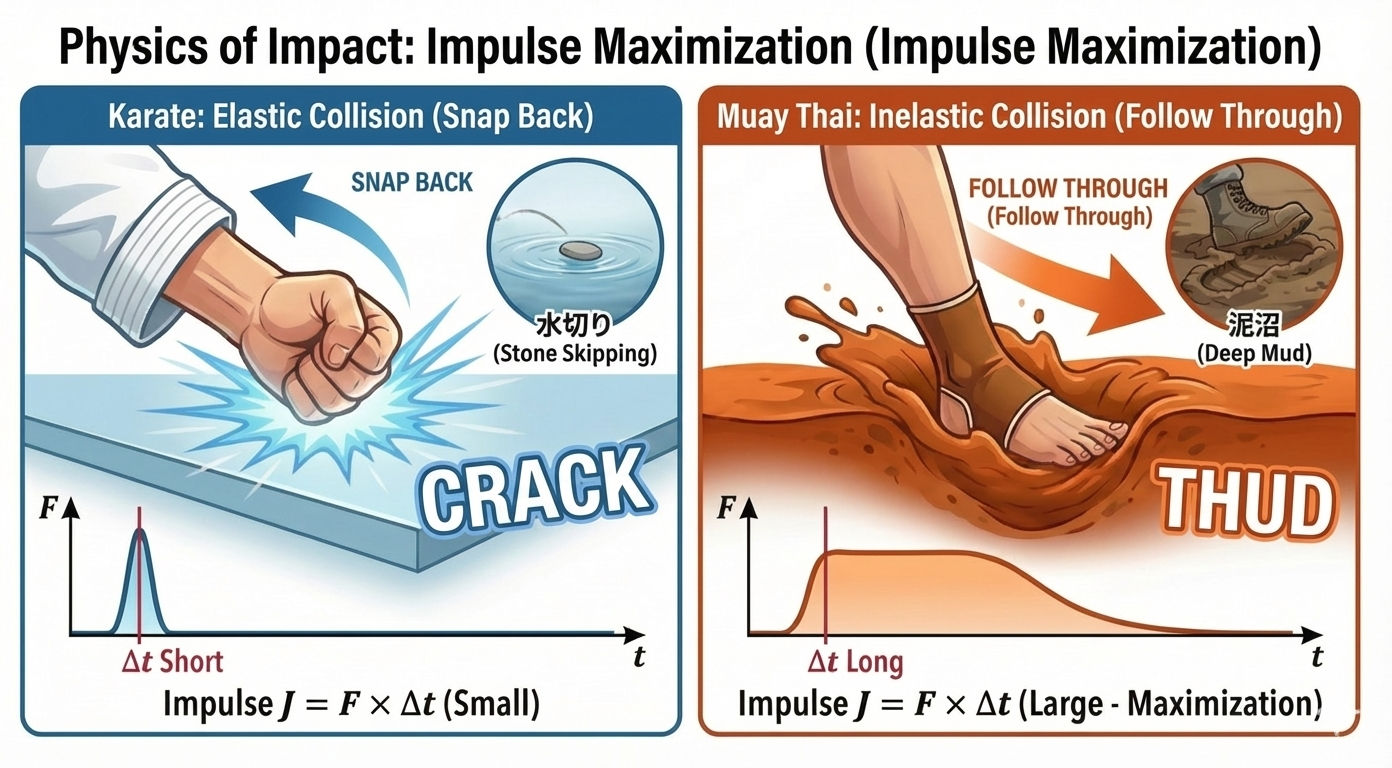
The left shows Karate’s elastic collision: leg retraction shortens contact time and produces a smaller impulse. The right shows Muay Thai’s inelastic collision: follow-through extends contact time, maximizes impulse, and transmits impact into deep tissue.
(To be continued in Part 3: the final installment moves into “the logic of the undefendable” and “the domain of the master.”)