The Camp is easier to understand if you stop thinking of it as a list of packages.
There is one core Muay Thai training system. You can build your stay around it, or you can live somewhere else and come in to train. Private Lessons solve specific individual problems. Kids have an age-appropriate route. Facilities, recovery, long-stay support and life in Chiang Mai sit around the training.
That is the whole structure.
The details matter, but the structure should be clear before you start comparing plans, room types or session counts.
For current prices, schedules, availability and booking conditions, use the official pages linked throughout this guide. This article explains how the different parts of The Camp fit together.
One training system, two main ways to join
The Camp’s core product is Standard Muay Thai Training.
There is not one “serious” curriculum for staying guests and a reduced tourist version for visitors. The training system is the same. What changes is how you access it and how much of your day you want to organize around Muay Thai.
The two main routes are:
- Stay & Train — accommodation plus Standard Muay Thai Training.
- Visitor Training — Standard Muay Thai Training without accommodation.
If Muay Thai is the main reason for your trip and you want to remove the daily commute, Stay & Train is the integrated route.
If you already have accommodation in Chiang Mai, live here, or simply want to train without staying onsite, use Visitor Training.
That distinction sounds simple because it is. The training does not become a different product because of where you sleep.
How The Camp trains
The Camp’s training model is built around three ideas:
- Close Attention — students should be seen, corrected and guided during the session.
- Technique-First Programming — training has a technical purpose; exhaustion by itself is not the goal.
- The Camp Training Loop — each 90-minute Standard Session follows a repeatable learning process.
The structure stays consistent. The technical theme changes.
A session may emphasize stance, footwork, boxing, kicks, knees, elbows, defence, movement or another appropriate theme depending on the group, level and recent training. The point is not to run one identical class script every day. The point is to keep a recognizable learning framework while changing the technical problem when it makes sense.
The current four-level structure is:
- First-Time
- Beginner
- Intermediate
- Advanced
Level placement exists to protect training quality, not to create status. A first-time student and an experienced competitor should not be solving the same training problem.
For the current official structure, see Muay Thai Training.
Complete beginner? Start there — do not pretend to be advanced
You do not need previous Muay Thai experience to train at The Camp.
Complete first-timers begin with Foundations work: posture, stance, footwork, balance, guard, shadowboxing and basic striking mechanics. These are not the boring preliminaries you rush through before “real” Muay Thai begins. They are the things the rest of Muay Thai is built on.
Beginners are expected to make mistakes. They are expected to be corrected. They are expected to repeat things.
They are not expected to prove toughness by training like advanced students.
Beginners do not spar at The Camp. Kick sparring is limited to suitable experienced participants and depends on head-coach approval, supervision and protective gear.
If you are new and want a fuller explanation of what the first sessions feel like, read Muay Thai for Complete Beginners at The Camp.
Experienced trainees need more than harder padwork
Intermediate and Advanced trainees need different problems: timing, distance, defence, decision-making, tactical understanding, cleaner application and more appropriate pressure.
“Harder” is not automatically the same as “better.”
An experienced trainee may train at a higher pace or volume, but the technical purpose still matters. Good training should not turn into random fatigue simply because the student is fit enough to survive it.
If you have a specific problem that deserves concentrated individual attention, a Private Lesson can supplement Standard Training.
That might mean a recurring technical weakness, focused Western Boxing work, fight preparation, or another narrow objective. A Private Lesson is useful when the goal is individual. It is not automatically the superior version of normal training.
For current Private Lesson information, use Visitor Training.
For the deeper decision guide, read When Private Muay Thai Lessons Make Sense at The Camp.
Stay & Train: make Muay Thai the rhythm of the day
Stay & Train is for guests who want accommodation and training in one place.
The practical advantage is not complicated: less friction.
You can train, return to your room, eat, work, rest, recover and train again without repeatedly rebuilding the day around transportation.
The current Stay & Train structure offers:
- Lite — up to two Standard Muay Thai Sessions per day.
- Full — up to four Standard Muay Thai Sessions per day.
The current minimum stay is two nights, and meals are not included in the standard package.
More available sessions do not automatically mean more progress. Full gives more training access, but access is not an obligation to force every session regardless of fatigue, experience or recovery.
For many complete beginners staying around one week, Lite is the usual place to start. Regular trainees, guests with strong fitness or people deliberately seeking a higher-volume training period may prefer Full.
For current package details and availability, use Stay & Train.
For the decision itself, read Lite vs Full Stay & Train.
Visitor Training, Private Lessons and Kids
You do not have to stay onsite to train at The Camp.
Visitor Training is the non-accommodation route. The Visitor Training page provides current information about:
- single sessions
- Training Passes
- level-based session guidance
- Private Lessons
- Kids Muay Thai
For Kids Muay Thai, the current group route is for ages 6–12. Complete beginners can join. Children under 6 may train only in an approved Private Lesson, with a parent or legal guardian on site. From age 13, a young trainee may join adult Standard Muay Thai Sessions when placement is appropriate and confirmed by the team.
Kids Muay Thai is structured training, not childcare.
Use Visitor Training for current training-only information, or go directly to Kids Muay Thai.
Parents who want more context can read Kids Muay Thai at The Camp: What Parents Should Know.
Training is only part of the day
A good Muay Thai stay is shaped by what happens between sessions as well as inside them.
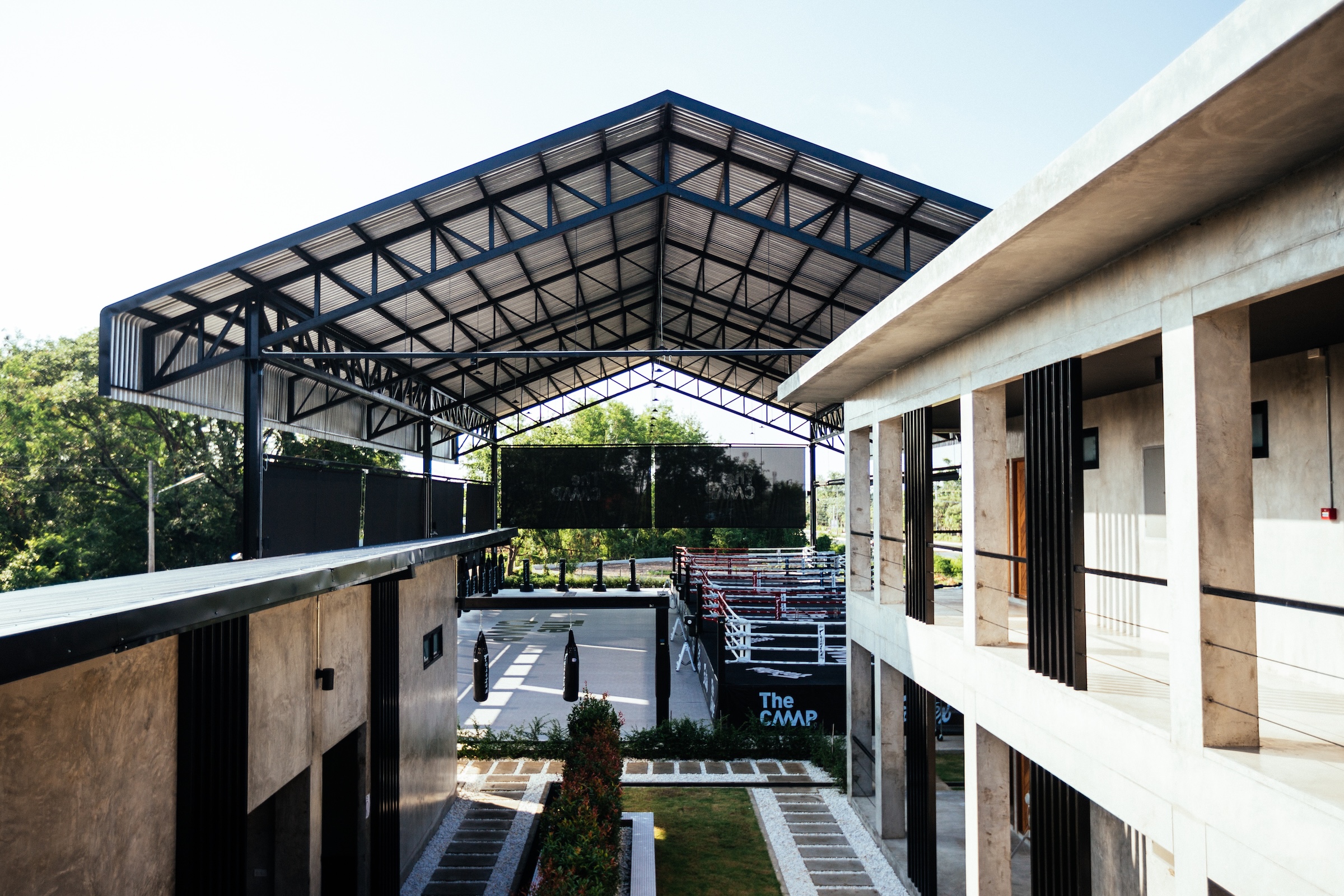
The Camp’s campus is designed to support daily life between sessions, with Wi-Fi, Lean & Green Café, recovery facilities, strength training, accommodation, laundry and other practical amenities. The Garage coworking facilities are planned to open in early 2027.
Lean & Green Café currently serves coffee and fresh drinks to guests. Its early 2027 expansion into The Garage will add café and dining service. The approved hours for The Garage coworking and café/dining are daily 07:00–21:00.
The expanded facilities are scheduled to open in early 2027.
For parking, Wi-Fi and laundry information, see the FAQ. For workspace, food and recovery information and opening status, see The Garage.
For a closer look at resting between sessions, from a good meal and a proper sleep to time among the trees and the tearoom, read Recover, Then Return.
Chiang Mai also gives you a life outside the gym. A rest day can be a rest day. It can also include food, wellness, culture, nature, pool time or selected local experiences without turning the day into another endurance event.
Longer stays change the problem
A three-day training visit and a three-month training stay are not the same project.
On a short stay, you may simply want to experience the gym and train hard for a few days.
Over several weeks or months, sustainability becomes more important. Coaches see you repeatedly. The same corrections come back. Technical habits have time to become more stable. Training volume, sleep, work, food and rest begin to matter as a system rather than as individual daily decisions.
The advantage of a long stay is not that every day can be extreme.
The advantage is that you have time to be consistent.
Visa support for longer training stays
Some long-stay students may consider an ED or DTV route.
The Camp provides school-side support for eligible Muay Thai students and prepares the applicable school-side documentation for supported program routes.
Eligibility and procedures depend on your intended stay, passport, visa history and current Thai immigration requirements. The Camp provides school-side support but cannot guarantee visa approval.
Start with KYI (Know Your Intent) and use Visa Support for current program details.
Which route makes sense for you?
Start with the practical question rather than the package name.
I want accommodation and Muay Thai to organize the trip.
→ Stay & Train
I already have accommodation or only want training.
→ Visitor Training
I want to understand how the training itself works.
→ Muay Thai Training
I am completely new to Muay Thai.
→ Complete Beginner Guide
I want focused individual work.
→ Private Lesson Guide
I am planning for a child.
→ Kids Muay Thai
I want to understand workspace, food and recovery at The Garage.
→ The Garage
I need practical information about parking, Wi-Fi or laundry.
→ FAQ
I am considering a long-stay visa route.
→ Visa Support
I just need a quick answer.
→ FAQ
My situation is specific.
→ Contact
The simplest way to understand The Camp
The Camp is not a collection of unrelated programs.
There is one core Muay Thai training system. You choose how it fits into your time in Chiang Mai.
Stay onsite or stay elsewhere. Train at the level that actually fits you. Add a Private Lesson when there is a specific reason. Use the facilities and the city to make the rest of the day sustainable.
Then keep doing the part that matters most:
Train, get corrected, repeat, recover, and come back able to do it again.