Thailand DTV Rules Tighten from 31 August 2026: What Muay Thai Students Need to Know

The Thailand DTV rules 2026 introduce significant changes from 31 August 2026, affecting where applicants can apply and the documents they must provide.
For Muay Thai students, the most important change is not simply that another document has been added. The practical effect is that the previous strategy of travelling to a convenient third country, such as Laos, to submit a DTV application is being sharply restricted.
The DTV has not been abolished. However, applicants should no longer assume that they can choose whichever Thai embassy or consulate is easiest or most convenient.
Source status for this update
As of 28 August 2026, this change has been confirmed through official Thai diplomatic-mission sources, including the Royal Thai Consulate-General in Savannakhet and the Royal Thai Embassy in London. The Royal Thai Embassy in Vientiane has also issued an official announcement stating that the new requirements take effect from 31 August 2026 and apply worldwide.
At the time of writing, we have not located a single central 2026 announcement from Thailand's Ministry of Foreign Affairs that consolidates all of these new DTV requirements in one document. Applicants should therefore continue to check the exact requirements of the Thai embassy or consulate responsible for their application.
What is changing from 31 August 2026?
Two changes are especially important.
1. DTV applications are becoming restricted by nationality, permanent residence and consular jurisdiction
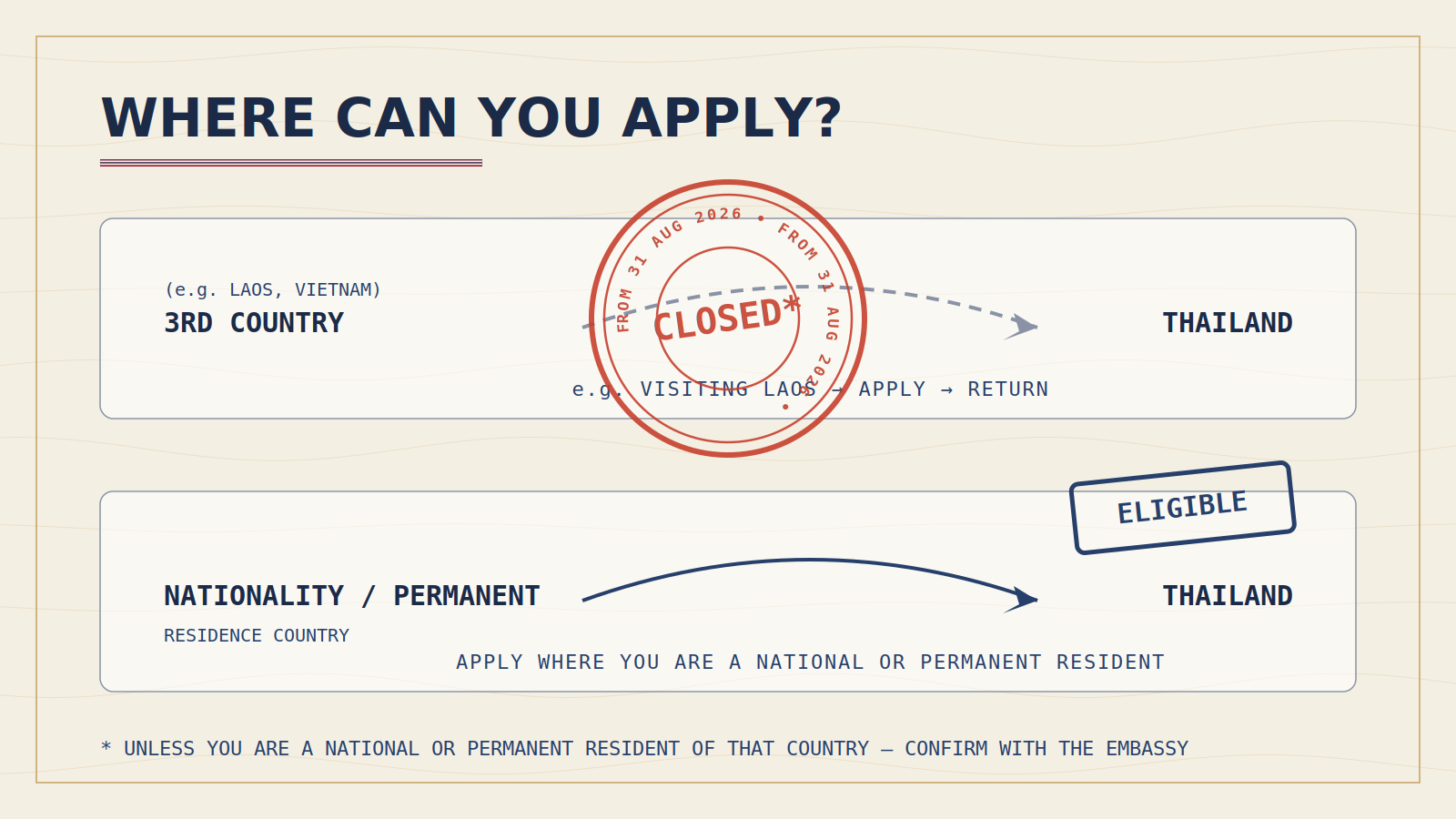
The Royal Thai Consulate-General in Savannakhet states that, from 31 August 2026, applicants must be permanent residents of the country where the visa application is submitted. For applications in Savannakhet, applicants must be Lao nationals or permanent residents of Lao PDR.
The Royal Thai Embassy in London has also published an important DTV update stating that, from 31 August 2026, proof of permanent residence in the UK, Ireland or the British Overseas Territories is compulsory for DTV applications.
The practical meaning is clear: applicants should no longer assume they can travel to a third country simply because the Thai embassy there appears easier, faster or more convenient.
For example, a US, UK, Australian or European traveller who is only visiting Laos should no longer assume that they can travel to Vientiane or Savannakhet and submit a DTV application there.
Applicants should expect to apply through a Thai embassy or consulate where they satisfy the nationality, permanent-residence or consular-jurisdiction requirements imposed by that mission.
2. Police clearance / criminal record clearance is becoming compulsory

The Royal Thai Consulate-General in Savannakhet states that applicants must provide a certificate of criminal record clearance issued by the authorities of Lao PDR or the applicant's country of nationality.
The Royal Thai Embassy in London states that, from 31 August 2026, DTV applicants must provide a police clearance certificate issued within six months of the date of submission. The London embassy gives examples such as an ACRO certificate or Irish police certificate.
The exact issuing authority, document age, translation requirements and legalisation requirements may vary by embassy or consulate. Applicants should therefore confirm the exact checklist of the mission handling their application.
The easy third-country application route is effectively closing
Until now, some applicants staying in Thailand would travel to a nearby country and apply for a DTV there because the process appeared easier, faster or more flexible.
Applicants should no longer rely on that strategy.
If an applicant is only visiting Laos as a tourist and does not satisfy the nationality or permanent-residence requirements imposed by the Thai mission there, that applicant should not expect to be able to use Laos simply as a convenient DTV application location.
The same principle applies more broadly. Applicants should not choose a Thai embassy or consulate in another country solely because they believe that mission is easier to deal with.
For anyone already in Thailand, this can materially increase the time, cost and preparation required for a DTV application.
What about DTV dependents?
Dependent applications should not be assumed to be exempt from the new documentation rules.
For example, the Royal Thai Embassy in London currently lists DTV3 for spouses and children under 20 and requires both proof of permanent residence and a police clearance certificate. The London embassy also states that dependents under 16 may submit the police clearance certificate of the primary DTV holder instead of their own.
However, dependent-document requirements may differ between Thai missions. Applicants applying as a spouse or child of a DTV holder should check the specific rules of the responsible embassy or consulate before submitting an application.
DTV has not been abolished
There has been no official announcement that the Destination Thailand Visa itself has been cancelled or abolished.
The DTV remains an official Thai visa category for eligible purposes, including Thai Soft Power activities such as Muay Thai.
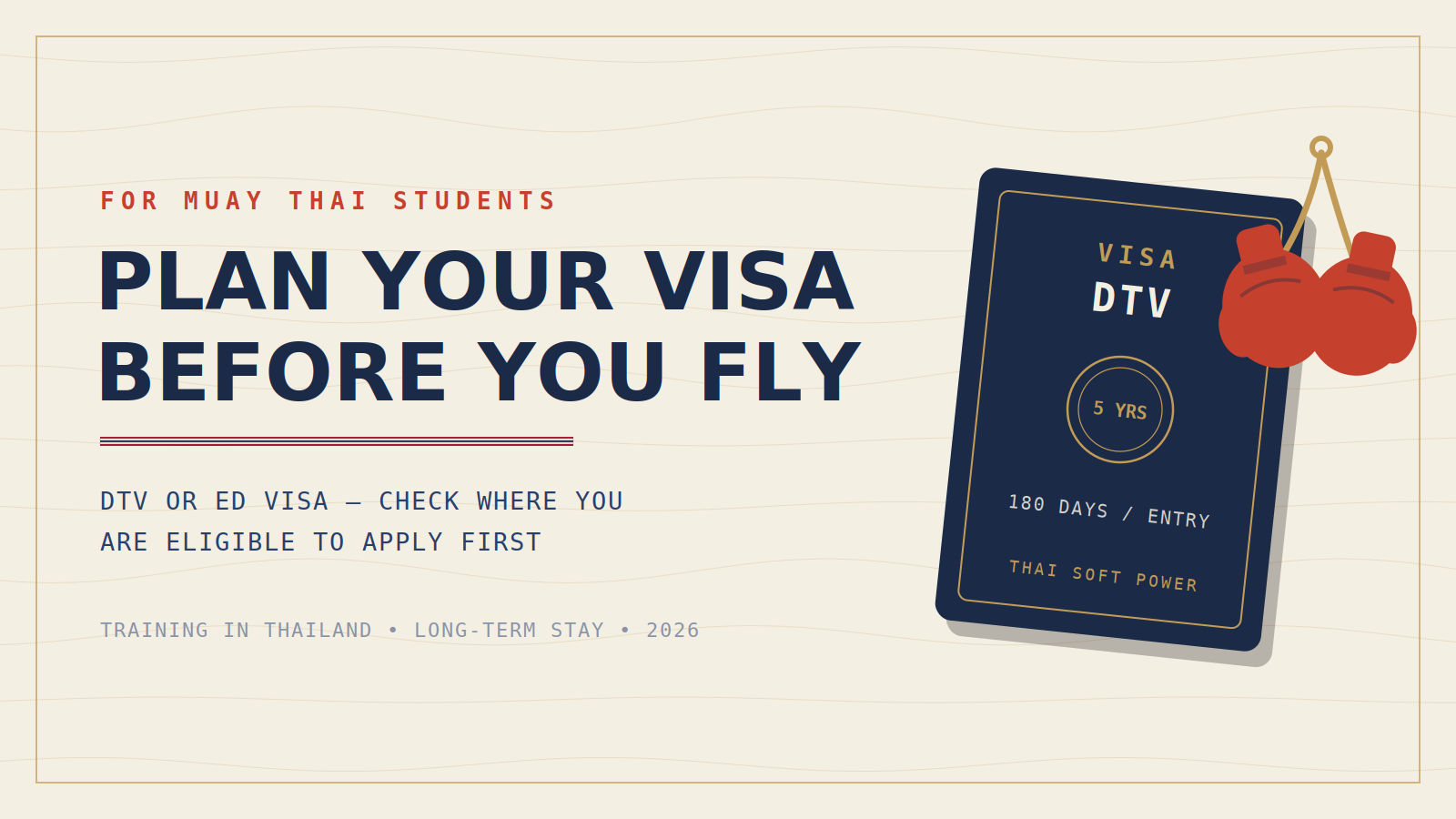
Official Thai information continues to describe the DTV as a five-year, multiple-entry visa with a permitted stay of up to 180 days per entry. Official guidance also states that an extension of stay of up to 180 days may be available once per entry through the Thai Immigration Bureau, subject to current rules and approval.
What has changed is the accessibility and screening of the application process.
A more accurate description is:
"DTV still exists, but Thailand is significantly tightening the application process and the easy third-country application route is being closed."
The Camp's DTV Muay Thai Program: 192 Lessons
There is an important distinction between DTV immigration rules and The Camp's Muay Thai training program.
The Camp's DTV Muay Thai Program includes:
- 192 Muay Thai lessons
We do not describe this as a "12-month DTV program."
The reason is simple: the validity and permitted-stay rules of the DTV are immigration matters, while the 192 lessons are The Camp's training-program structure. These are separate concepts and should not be confused.
Therefore, when we refer to The Camp's DTV route, the correct description is:
"The Camp DTV Muay Thai Program – 192 Lessons"
The 192-lesson structure is comparable to the lesson volume used in our long-term ED Visa training route, but it should not be interpreted as a statement that the DTV itself grants a continuous 12-month stay.
Any question about how long a DTV holder may remain in Thailand, extensions, re-entry, embassy jurisdiction or current application eligibility must be checked against the latest official Thai immigration and embassy rules.
What does this mean for Muay Thai students?
For people considering long-term Muay Thai training in Thailand, DTV planning has become more demanding.
Applicants should now consider:
- where they are legally eligible to submit the DTV application;
- whether they can provide the required proof of nationality, permanent residence or jurisdictional status;
- whether they can obtain the required criminal record clearance;
- the processing time needed before travelling;
- whether DTV remains the most practical visa route for their actual training plan.
The previous assumption that someone could first come to Thailand and then simply make a short trip to a nearby country to obtain a DTV should no longer be used as general advice.
Will ED Visa become more important again?
Thailand has not officially announced that DTV will be replaced by ED Visa, and it would be incorrect to present that as confirmed government policy.
However, from The Camp's practical perspective, the tightening of the DTV application process may make the ED Visa a more relevant and practical option again for people whose main purpose is genuine long-term Muay Thai training.
Guests should therefore not automatically assume that DTV is the easiest long-term option simply because Muay Thai is recognised as a Thai Soft Power activity.
The appropriate route depends on the applicant's nationality, residence status, intended stay, training purpose and the rules in force at the time of application.
What about applications already submitted before 31 August 2026?
The Royal Thai Embassy in Vientiane stated in its official announcement that applicants who had already submitted their DTV application and completed visa-fee payment before 31 August 2026 would not be affected by the new requirements announced there.
Applicants with an application already in progress should nevertheless confirm their individual status directly with the Thai embassy or consulate processing the application.
The new requirements do not constitute an announcement cancelling DTV visas that have already been validly issued.
What should you do if you are considering DTV now?
Do not make visa-run or third-country travel plans based on old DTV advice.
Before making travel arrangements:
- identify the Thai embassy or consulate that can accept your application under its current jurisdiction rules;
- check its current DTV requirements;
- confirm what proof of nationality, permanent residence or local immigration status is required;
- obtain the required criminal record clearance;
- confirm whether translations or legalisation are required;
- allow enough time for document preparation and visa processing.
Visa and embassy procedures can change quickly. Always confirm the latest requirements before submitting an application.
Planning long-term Muay Thai training at The Camp
If your main purpose is long-term Muay Thai training at The Camp and you are considering DTV or ED Visa, please start with our official Visa Support process.
The Camp does not determine nationality-specific immigration eligibility through general chat. Our role is to provide information about The Camp's training program and school-side documentation, while current visa eligibility and embassy requirements remain subject to Thai government rules and the responsible Thai diplomatic mission.
The Camp Visa Support App / KYI:
Official sources checked for this update
- Royal Thai Consulate-General, Savannakhet — Destination Thailand Visa (DTV):
- Royal Thai Embassy, London — Visa General Information / Important DTV Update:
https://london.thaiembassy.org/en/page/visa-general-information?menu=64cd03802f080d54bb16df93
- Royal Thai Embassy, London — Destination Thailand Visa:
https://london.thaiembassy.org/en/page/destination-thailand-visa
- Ministry of Foreign Affairs of Thailand — DTV official information:
https://image.mfa.go.th/mfa/0/RzaiZWKBzF/consular/Visa/18.Destination_Thailand_Visa_(DTV).pdf
- Ministry of Foreign Affairs of Thailand — New Visa Measures / DTV overview:
https://image.mfa.go.th/mfa/0/91fPdh6NtO/VISA_Information/New_Visa_Measures_July_2024.pdf
- Royal Thai Embassy, Vientiane — Official DTV announcement regarding requirements effective 31 August 2026 (official social-media announcement captured 28 August 2026).
Disclaimer: Visa and immigration rules may change without notice. This article is general information, not legal advice. Final eligibility and application requirements must be confirmed with the responsible Royal Thai Embassy, Royal Thai Consulate-General, or Thai Immigration authority.