
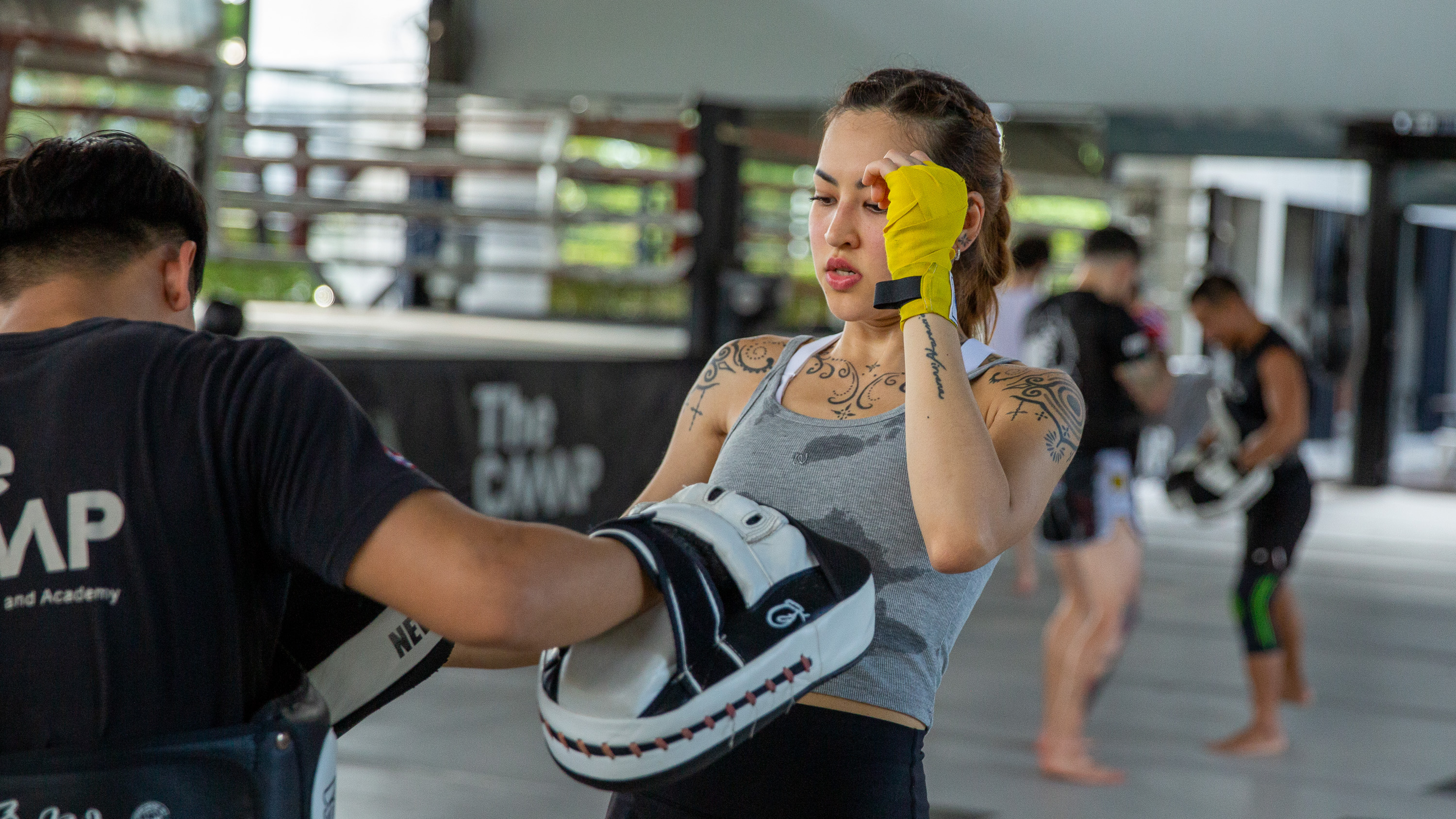
An owner’s personal perspective on choosing a Muay Thai gym in Thailand, and the principles behind The Camp Chiang Mai.
The short answer: Start with your own goals. Then look at the teaching, individual attention, safety, hygiene, professional conduct and everyday environment. Compare what you receive for your time and money, and try the gym before a long commitment when possible. A famous name or a low price alone cannot tell you whether it is right for you.
In this article
- Start by asking yourself what you actually want
- Training quality comes first
- Look at how many students each trainer is actually responsible for
- Do not just ask who teaches there. Ask what the gym teaches
- Language matters more than people think
- Look carefully at safety and level separation
- For me, hygiene is not a minor detail. It is one of the most important things
- A great fighter is not automatically a great trainer
- A famous gym will not make you famous — or necessarily better
- Location matters, especially when you stay longer
- The hours outside training matter too
- Ask yourself whether you actually want to spend every day there
- Price matters — but value matters more
- Read reviews for patterns, not drama
- A gym’s website can tell you more than its photographs
- Before making a long-term commitment, try it if you can
- The most expensive thing you are spending is not your money
Thailand has no shortage of Muay Thai gyms.
From Bangkok to Chiang Mai, Phuket and beyond, there are thousands of places to train: famous fighter gyms, large international academies, small old-school local camps, destination training resorts, and everything in between.
Having so much choice should make finding a gym easier.
In reality, it often makes it harder.
This is especially true if you are new to Muay Thai. To an inexperienced eye, many gyms look remarkably similar. There is a ring. There are heavy bags. Trainers hold pads. Someone is throwing a roundhouse kick for Instagram.
What those photographs cannot tell you is what it will actually feel like to train there — or, more importantly, how much you will actually learn.
So people naturally fall back on the things they can see.
The cheapest price.
The most famous name.
A well-known fighter.
A beautiful social-media feed.
None of those things is inherently wrong. But none of them, on its own, tells you whether a gym is right for you.
And that is the first point I would make:
There is no single “best Muay Thai gym.” There is only the gym that is best suited to what you are trying to achieve.
Start by asking yourself what you actually want
Before comparing gyms, decide what you want from Muay Thai.
Are you hoping to fight?
Do you want to become a professional fighter?
Are you completely new and looking to build proper fundamentals?
Are you training mainly for fitness?
Are you in Thailand for one day and simply want to experience Muay Thai once?
Or are you planning to spend several weeks or months here and genuinely improve?
These are very different objectives, and they may require very different gyms.
An old-school fighters’ camp that sends athletes into the ring every week may be an exceptional environment for a young professional prospect. It may not be the ideal environment for a 45-year-old beginner who has never worn boxing gloves before.
And the reverse is equally true.
So before asking, “Which gym is the best?”, ask a more useful question:
“What do I want Muay Thai to give me?”
That should be the starting point.
I should also be transparent about where the ideas in this article come from.
I am not writing this as a completely detached third-party reviewer of Muay Thai gyms. I am writing it as someone who loves Muay Thai and who has spent years thinking about what I personally want from a training environment.
In fact, many of the principles below are the same principles behind the way we have built THE CAMP.
I wanted to create the kind of Muay Thai gym that I myself would want to train in.
A place that teaches fundamentals properly.
A place where students are actually watched and corrected.
A place with exceptionally high standards of hygiene.
A place where trainers behave like professionals.
A place where safety matters.
And a place where someone can stay for more than a few days and still enjoy the life surrounding the training.
So this is not an attempt to pretend that I have no point of view.
I do.
This is simply one Muay Thai lover’s view of what matters when choosing a gym. Take from it whatever is useful to you.
Training quality comes first
If you are travelling to Thailand to learn Muay Thai, then the quality of the training should obviously come first.
But there is an important distinction between doing Muay Thai and being taught Muay Thai.
You can move your arms and legs.
You can hit a heavy bag.
You can kick pads.
You can sweat for 90 minutes and leave exhausted.
That can be a perfectly good workout.
But it does not necessarily mean that anyone has taught you anything.
If you genuinely want to improve, fundamentals matter enormously.
Your stance.
Your guard.
Your balance.
Your footwork.
Your punches.
Your kicks.
Your defence.
These things may look basic, but they determine almost everything that follows.
In that sense, Muay Thai reminds me a little of golf: what happens at the beginning matters far more than many people realise.
If you learn poor mechanics early, you do not simply make one mistake. You begin building new techniques on top of an unstable foundation.
I have seen people train for one or two years this way. Somewhere near the beginning, a button was fastened into the wrong hole, and everything afterwards followed from it.
Eventually the bad habits become so deeply ingrained that progress slows dramatically.
The opposite is also true.
When someone develops solid fundamentals from the beginning, subsequent progress can be surprisingly fast.
That is why I believe beginners, perhaps even more than experienced fighters, should ask:
“Is this gym actually teaching me the basics properly?”
Not merely:
“Did I have fun and work up a good sweat?”
Look at how many students each trainer is actually responsible for
A gym can be enormous, busy and full of energy.
That can look impressive.
But from a training perspective, size is not necessarily an advantage.
One of the things I look at is the trainer-to-student ratio.
If one trainer is responsible for dozens of people at the same time, there is a natural limit to how much individual attention anyone can receive.
You may still have a great workout.
You may follow the class, hit the pads, kick the bags and leave feeling exhausted.
But if your objective is technical improvement, somebody needs enough time to notice why your guard drops, why you lose your balance after a kick, why your punch is not transferring power efficiently, or why your footwork keeps putting you in the wrong position.
Correction requires observation.
Observation requires time.
So I care much less about how impressive a gym looks when it is full, and much more about a simple question:
How much attention will actually be paid to me?
Being one person in a vibrant class can be enjoyable.
Being merely one of fifty people whom nobody is really watching is something else.
Do not just ask who teaches there. Ask what the gym teaches
This is one of the most overlooked aspects of Muay Thai training.
Many gyms depend heavily on the individual style, knowledge and personality of each trainer.
One trainer tells you to do something one way.
The next trainer tells you the opposite.
A third trainer introduces yet another method.
For an experienced fighter, it may be possible to absorb different perspectives and decide what works.
For a beginner, it can simply be confusing.
There is another problem with trainer-dependent gyms.
If the entire quality of a gym rests on one exceptional coach, what happens when that coach leaves?
The identity of the training can disappear with him.
That is why I look beyond individual trainers and ask whether the gym itself has a coherent teaching philosophy and methodology.
Of course every trainer should have individuality. Different coaches will always have different strengths, experiences and favourite techniques.
That is healthy.
But underneath those individual differences, there should be a common foundation.
The fundamentals should remain consistent.
The teaching logic should remain consistent.
A student should not feel as though he has entered a completely different martial art simply because Tuesday’s trainer is different from Monday’s.
To me, that consistency is one of the signs of a genuinely well-run training programme.
Language matters more than people think
You can learn a surprising amount of Muay Thai by watching.
But there is a limit to what can be taught through imitation and gestures.
Why should the weight be here rather than there?
Why does this angle generate more force?
Why is the hip turning at this moment?
Why are you losing power at the end of the punch?
Why does one defensive position leave you vulnerable while another does not?
Combat sports involve biomechanics, anatomy, timing, leverage and the transfer of force.
At some point, explanation matters.
For most international students in Thailand, that means it helps enormously if there is at least enough English to have a real technical conversation.
The trainer does not need to speak perfect English.
That is not the point.
The point is whether you can ask, “Why?” and receive an answer you understand.
If your entire learning process consists of someone pointing at your leg and saying “No, no — like this,” there will eventually be a ceiling on how much you can understand.
Look carefully at safety and level separation
Hard training and good training are not the same thing.
Particularly if you are a beginner, look at how a gym separates different levels and how it manages activities such as sparring.
Does everyone spar simply because they want to?
Or does the gym first look at technique, defence, experience and — very importantly — the ability to control power?
Sparring does not affect only your own safety.
It affects your partner’s safety as well.
A well-run gym should understand progression.
Beginners should be allowed to build the skills necessary for the next stage rather than being thrown into situations they are not ready to handle.
There is nothing impressive about getting injured in the first three days of a two-week Muay Thai holiday and spending the remaining eleven days unable to train.
A good gym should be capable of making you better without unnecessarily breaking you in the process.
For me, hygiene is not a minor detail. It is one of the most important things
This deserves far more attention than it usually receives.
When I created a Muay Thai gym, one of the areas I cared about most was hygiene.
Not interior design.
Not whether the gym looked expensive.
Hygiene.
A Muay Thai gym is, by its very nature, a difficult environment to keep clean.
People sweat heavily.
They train barefoot.
They touch the floor.
They strike the same heavy bags.
They use pads, gloves and equipment that may be handled repeatedly throughout the day.
Sweat, skin oils and saliva inevitably find their way onto surfaces and equipment.
At the same time, combat sports frequently involve small cuts, grazes and abrasions.
Put those two things together and hygiene stops being an aesthetic issue.
It becomes a health and safety issue.
Minor skin infections can begin through very small breaks in the skin. A contaminated cut can become infected and, in more serious cases, infections such as cellulitis can occur.
For factual background on infection risks in shared sports environments, see the CDC’s guidance for athletes on skin infections and hygiene.
So when I inspect a gym, I do not merely ask whether it looks tidy.
I ask how seriously hygiene is actually taken.
And there is an important distinction here.
Almost every gym will tell you that it is clean.
But the word clean means very different things to different people.
What is regarded as perfectly acceptable hygiene in one local environment may fall well below what an international guest from Japan, Europe or elsewhere considers acceptable.
I have seen places that sincerely describe themselves as clean while, by my own standards, they are nowhere close.
So I am not interested simply in whether a gym “cleans.”
I want to know to what standard it cleans.
Are the mats properly cleaned and disinfected?
Are sweat-covered areas dealt with promptly?
What happens to pads and other heavily handled equipment?
Are toilets and showers genuinely hygienic, or have they simply had some water thrown across the floor?
Is there a persistent smell?
Are shared items properly maintained?
These things matter to me.
My own benchmark is deliberately extreme.
I sometimes describe it this way:
Would I be comfortable if my baby were crawling across this floor?
Obviously, I am not suggesting that babies belong on Muay Thai mats.
The point is the standard.
That is how clean I want the environment to feel.
I do not accept the argument that a Muay Thai gym is supposed to be dirty.
Nor do I accept that poor hygiene should simply be dismissed as part of the authentic Thai experience.
Quite the opposite.
A place where large numbers of people sweat, train barefoot and share equipment should, in my view, maintain higher, not lower, hygiene standards.
A gym does not need to be luxurious.
The equipment does not need to be brand new.
But on hygiene, I personally do not like compromise.
A great fighter is not automatically a great trainer
Another thing I care about deeply is trainer behaviour and professional ethics.
Being an accomplished Muay Thai fighter and being a good teacher are not the same skill.
A trainer may have had an extraordinary fighting career and still be a poor coach.
If he arrives late for class, loses interest halfway through a session, stands around without correcting anyone, ignores obvious mistakes or turns up smelling of alcohol, his fight record does not solve the problem.
I want trainers who behave like professionals.
And professionalism also includes boundaries.
Muay Thai sometimes requires physical contact between trainer and student. A coach may need to adjust posture, arm position, hip angle or balance.
That is part of instruction.
But professional trainers understand the difference between necessary technical correction and unnecessary touching.
This becomes particularly important with female guests.
No student should travel across the world to learn Muay Thai and return home remembering the experience primarily because a trainer made her uncomfortable.
A serious gym should therefore have clear conduct rules.
Trainers should be expected to arrive on time.
They should concentrate on the class.
They should treat guests respectfully.
They should understand appropriate physical boundaries.
Harassment should not be tolerated.
And if something inappropriate happens, management should deal with it.
The important point is that professionalism should not depend entirely on whether an individual trainer happens to be a good person.
There should be standards set by the gym itself, and those standards should be enforced.
A famous gym will not make you famous — or necessarily better
People are naturally attracted to famous gyms and famous fighters.
I understand that completely.
Training in the same building as a fighter you admire can be exciting. Taking a photograph together can become one of the great memories of a trip.
There is nothing wrong with that.
But if the objective is to improve your own Muay Thai, fame is a different question.
The fact that a world-class fighter trains at a gym does not automatically mean that somebody will spend time fixing your stance.
It does not mean anyone will correct your guard.
It does not mean somebody will notice the problem with your kick.
A famous person being in the building and you receiving excellent coaching are not the same thing.
So enjoy the famous name if that matters to you.
Just do not confuse prestige with personal attention.
Location matters, especially when you stay longer
For one training session, location may not matter very much.
For one month, it matters a great deal.
A gym in the middle of nowhere can feel wonderfully exotic for a few days.
After several weeks, travelling a long distance every time you want a coffee, a different meal, a pharmacy, a supermarket or a hospital may become considerably less romantic.
At the same time, I personally would not choose the middle of a nightlife district if my main objective were serious training.
Noise, alcohol, late nights and constant distractions do not necessarily create the easiest environment in which to train, eat, recover and repeat.
My preference is somewhere in between.
Far enough from the centre to feel removed from the noise and distractions of the city.
Close enough that civilisation has not disappeared.
That balance gives you the chance to concentrate on Muay Thai without making ordinary life unnecessarily difficult.
The hours outside training matter too
Modern Muay Thai facilities increasingly offer more than a ring and some heavy bags.
Saunas.
Ice baths.
Swimming pools.
Cafés.
Restaurants.
Workspaces.
These things may not teach you how to throw a better elbow, but that does not make them unimportant.
If you are staying for a week, two weeks or several months, the class itself occupies only a small part of your day.
You may train in the morning, eat, have coffee, work for several hours, rest, train again in the afternoon and then recover afterwards.
If all of that can happen comfortably within the same environment, or close to it, the entire experience becomes easier.
Some people love extremely simple, old-school Muay Thai camps.
Others prefer a place where training, recovery, food and work can coexist.
Neither preference is wrong.
But if you are going to stay for some time, do not evaluate only the 90-minute class.
Think about the rest of your day as well.
Ask yourself whether you actually want to spend every day there
There is another factor that is difficult to put into a price list.
Culture.
The trainers.
The staff.
The other guests.
The general atmosphere.
How people speak to each other.
How welcome you feel.
Whether going to the gym every morning feels exciting or draining.
If you stay for a month, these people become part of your daily life.
That means the question is no longer merely:
“Is this a good training facility?”
It also becomes:
“Do I actually want to spend my time around these people?”
Do not underestimate that.
Price matters — but value matters more
I do not believe that expensive automatically means good.
I also do not believe that cheap automatically means bad.
There are inexpensive gyms with excellent trainers.
There are expensive gyms where a student can disappear into the crowd.
So I would not judge a gym purely by its price.
I would look at the relationship between price and value.
And that means looking carefully at what is actually included.
Two gyms may charge the same amount for a class but provide entirely different experiences.
How large is the class?
How much individual correction do you receive?
How much pad work is included?
Which facilities can you use?
Are equipment rentals included?
Can you use a sauna or ice bath?
What other services form part of the experience?
The right question is not simply:
“How much does it cost?”
It is:
“What am I receiving for that money?”
I would also be cautious about arriving in Thailand with the assumption that everything should be cheap.
Quality costs money to provide.
Good trainers cost money.
Proper staffing costs money.
Maintaining equipment costs money.
High hygiene standards cost money.
Good facilities cost money.
That does not mean you should automatically choose the most expensive option.
It means you should look for balance.
Read reviews for patterns, not drama
Reviews can be extremely useful when trying to judge a gym you have never visited.
But individual reviews should be read with perspective.
In any business serving hundreds or thousands of customers, there will occasionally be someone who writes an extraordinarily enthusiastic review.
There will also occasionally be someone who writes an extraordinarily hostile one.
A single emotional review, whether glowing or furious, tells me relatively little.
What I look for is repetition.
Do many different guests say that trainers give individual attention?
Do beginners repeatedly mention that they were taught patiently?
Do multiple people comment on the hygiene?
Do people consistently describe the staff as professional?
Those patterns are useful.
The same applies in the opposite direction.
If several unrelated guests, at different times, report that trainers are routinely late, that staff behave unprofessionally, or that female guests experienced inappropriate behaviour, that deserves attention.
One extreme opinion may simply be one extreme opinion.
A pattern is something else.
So I do not ask:
“What did the angriest reviewer say?”
I ask:
“What do many different people keep saying?”
That distinction matters.
A gym’s website can tell you more than its photographs
I also pay attention to a gym’s website.
Not because a beautiful website proves that the training is good.
It does not.
Some excellent local gyms have extremely basic websites — or almost no website at all.
What interests me is whether a gym can clearly explain itself.
What does it believe in?
How does it train beginners?
What are the class structures?
What is included in the price?
What are the rules?
How does it think about safety?
What policies exist?
Does it answer the obvious questions a guest is likely to have?
A gym that has thought carefully about its operation can usually explain what it does and why it does it.
A clear website does not guarantee a good gym.
But clarity often tells you something about the organisation behind it.
I would therefore look at the website, social media and reviews together.
Together, they can reveal quite a lot about the culture of a place before you ever walk through the door.
Before making a long-term commitment, try it if you can
Ultimately, nothing replaces seeing a gym for yourself.
You can read the entire website.
You can study Instagram.
You can read a hundred reviews.
And there will still be things you cannot know until you walk into the gym.
So whenever possible, before making a long-term commitment, try it.
One class.
One day.
A few days.
That may be enough.
Does the trainer arrive on time?
Does anyone actually watch you?
Is the gym really as clean as it looked online?
Do staff answer questions properly?
Does the reality match the promises?
Do you like the atmosphere?
Most importantly, do you feel that you want to come back tomorrow?
A long Muay Thai stay is not like booking a hotel room.
The gym becomes part of your daily life.
Trust your own eyes as well as everybody else’s opinion.
The most expensive thing you are spending is not your money
This is ultimately the point I care about most.
When choosing a Muay Thai gym, money matters.
But your most valuable investment is not money.
It is time.
You rearrange your work and your life.
You buy a plane ticket.
You travel across the world.
Then you give a week, two weeks, a month — perhaps much longer — of your life to training.
Imagine two people spending the same seven days in Thailand.
One disappears into a large class, works hard, sweats a lot and returns home unsure of what he actually learned.
The other receives corrections, improves his fundamentals, understands mistakes he had never noticed before and finishes the week feeling genuinely different from the person who arrived.
Both spent seven days.
But they did not receive the same value from those seven days.
Money can be earned again.
A week of your life cannot.
That is why I would not simply search for the cheapest gym.
Nor would I automatically choose the most expensive, the most famous or the most luxurious.
I would look at the whole picture.
The quality of the teaching.
The fundamentals.
The trainer-to-student ratio.
The consistency of the teaching methodology.
Communication.
Safety.
Hygiene.
Professional conduct.
Location.
The environment outside training.
The culture.
And finally, the balance between price and value.
You do not need to find the best Muay Thai gym in Thailand.
I am not even sure such a thing exists.
You need to find something much more useful:
the Muay Thai gym that is right for you.
If this guide helps you do that, then it has done its job.